
Why U.S. Companies Are Outsourcing Software to Latam
Outsourcing software to Latin America has become a strategic move for U.S. technology companies facing talent shortages, rising costs, and increasing pressure to deliver faster. Nearshore development in Latam offers a strong mix of technical expertise, cost efficiency, cultural alignment, and real-time collaboration. The region’s growing tech ecosystems have produced highly skilled developers and innovation hubs that align closely with U.S. work culture. This article explores why Latam has emerged as a leading nearshore destination and how U.S. companies can successfully get started.

By Mary Ontiveros
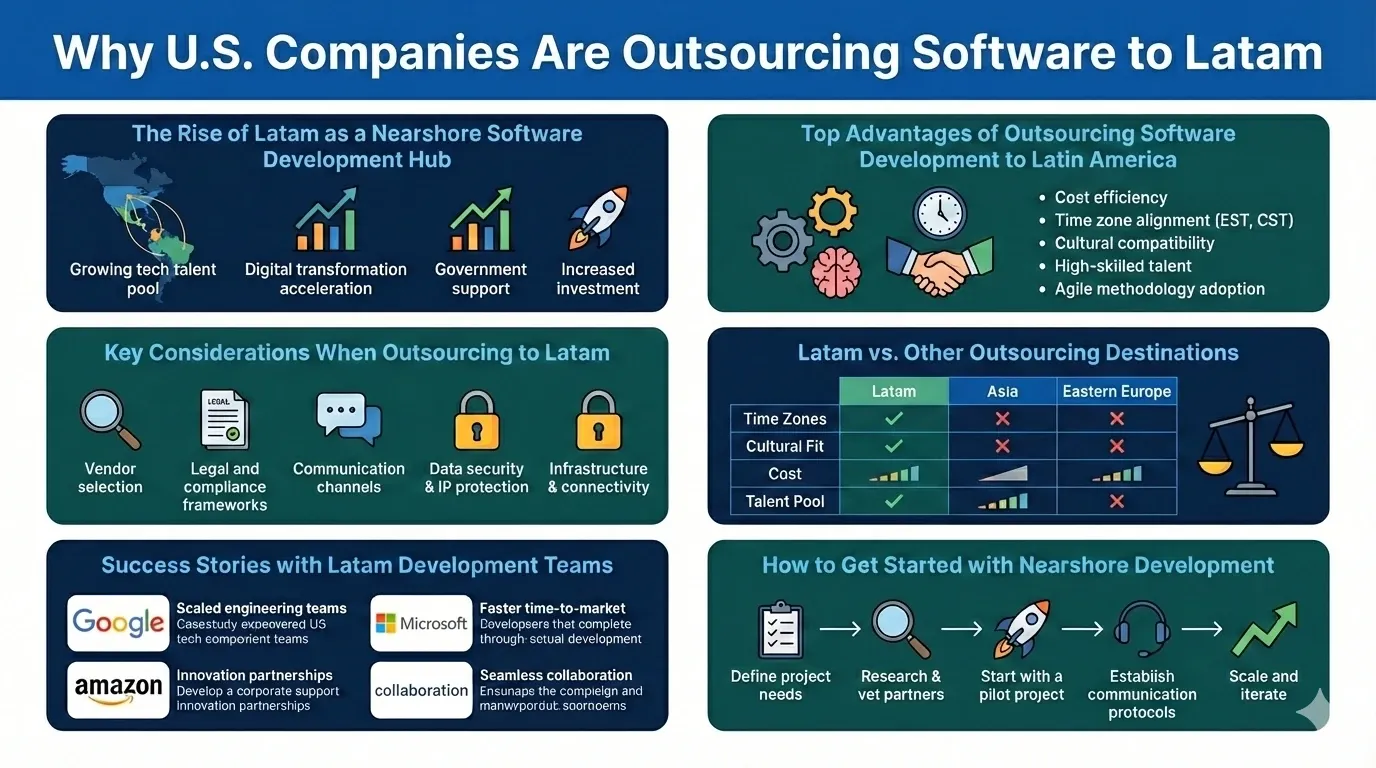
The Rise of Latam as a Nearshore Software Development Hub
Market growth and regional momentum
Over the last decade, Latin America has evolved into a thriving technology hub, driven by strong investments in STEM education, expanding innovation districts, and a surge in local and international tech companies. Countries like Brazil, Mexico, Argentina, Colombia, and Costa Rica are now home to more than 1.2 million software developers—one of the fastest‑growing talent pools in the world. Major global companies such as Google, Microsoft, IBM, Amazon, and Oracle now operate engineering centers across these nations, further fueling the region’s growth and competitiveness. This momentum has positioned Latin America as an ideal nearshore partner for U.S. companies seeking high‑quality development aligned with their business hours.
Why now? The factors driving nearshore adoption
Several global forces have converged to accelerate nearshore outsourcing to Latam. The U.S. faces a shortage of more than one million technology roles, making local hiring increasingly difficult and expensive. Remote work has become standard practice, eliminating barriers to distributed teams and enabling seamless international collaboration. Operational costs in the U.S. continue to climb, pushing both startups and large enterprises to consider cost‑efficient alternatives without sacrificing quality. Finally, the rapid pace of digital transformation has increased the need for faster delivery cycles, something Latam teams can support with agile methodologies and real‑time communication.
Top Advantages of Outsourcing Software Development to Latin America
Timezone alignment and real‑time collaboration
One of the most compelling advantages of outsourcing software to Latam is the alignment of working hours. Most Latin American countries operate within one to three hours of U.S. time zones, enabling real‑time collaboration across cross‑functional teams. Daily standups, sprint reviews, planning sessions, and urgent troubleshooting can occur without the delays common with offshore teams located 10–15 hours away. This time zone proximity improves productivity, reduces miscommunication, and makes it easier for teams to maintain agile development cycles.
Cost‑effectiveness without compromising quality
Outsourcing to Latam provides significant savings—often between 40% and 60% compared to U.S. hiring—without sacrificing technical excellence. A senior U.S.-based software engineer may earn between $120,000 and $180,000 annually, while a developer with similar expertise in Latin America typically earns $50,000 to $80,000, depending on the country and specialization. Cost-of-living differences rather than skill disparities drive these savings. Latam developers are trained in top-tier universities and coding academies, highly familiar with modern frameworks, and actively engaged in global open‑source communities.
A highly skilled and diverse technical talent pool
The technical talent across Latin America spans all major modern technologies. Developers routinely work with React, Angular, Vue, Next.js, Node.js, Python, Java, .NET, and Go, alongside mobile technologies such as Swift, Kotlin, React Native, and Flutter. Cloud specialists across AWS, Azure, and Google Cloud are abundant, as are engineers experienced in AI/ML, blockchain, IoT, DevOps, cybersecurity, and data engineering. Many developers speak English fluently and have experience collaborating with U.S. companies, making communication and expectations alignment straightforward.
Cultural compatibility and communication
Cultural alignment plays a major role in the success of outsourcing partnerships. Latin America shares many professional and cultural similarities with the U.S., including communication styles, collaboration methods, and business expectations. Developers across the region tend to work transparently, proactively, and with strong ownership, attributes that fit naturally within agile software development. Additionally, the prevalence of English fluency among tech professionals has grown significantly, allowing complex technical concepts to be communicated clearly and effectively.
Proximity and ease of travel
Geographic proximity is another strong advantage. Most major U.S. cities offer direct flights to Latin American technology hubs, with travel times averaging between 3 and 8 hours. This makes in‑person kickoff meetings, periodic workshops, and team‑building sessions easy and cost‑effective. The ability to meet physically, especially for long‑term projects, helps strengthen relationships, build trust, and align teams more effectively.
Key Considerations When Outsourcing to Latam
Choosing the right development partner
While the region offers immense potential, selecting the right partner is essential. Companies should look for providers with a proven track record working with U.S. clients, strong technical expertise in the required tech stack, and a clear communication process supported by modern project management tools. Evaluating cultural fit, scalability options, and transparency is equally important. A capable partner should offer flexibility, detailed reporting, and demonstrated experience delivering projects of similar complexity.
Legal and compliance framework
U.S. companies must ensure that nearshore partners have robust legal structures for intellectual property protection, data privacy, and cybersecurity. Most Latin American countries follow regulations aligned with international standards, but companies must still put strong contracts in place. Compliance with GDPR, CCPA, HIPAA, or industry‑specific requirements should be verified, along with the partner’s adherence to certifications such as ISO 27001 or SOC 2.
Infrastructure and technology capabilities
Modern nearshore partners in Latam invest heavily in enterprise-grade infrastructure, including redundant internet connectivity, secure cloud environments, VPNs, access controls, and robust backup procedures. U.S. companies should evaluate a provider’s technology environment to ensure stability, security, and the ability to support distributed teams effectively.
Latam vs. Other Outsourcing Destinations
Comparison with Eastern Europe
Eastern Europe has historically been a strong outsourcing region for European companies, but for U.S. businesses, Latin America offers clear advantages. Time zone differences between the U.S. and countries like Poland, Ukraine, or Romania can reach up to 10 hours, limiting real-time collaboration. While technical skills and cost structures are similar, Latam provides easier travel, stronger cultural alignment, and better opportunities for synchronous teamwork.
Comparison with Asia
Asia, particularly India, Vietnam, and the Philippines, remains a major global outsourcing hub. However, the significant time zone differences make real‑time collaboration challenging for U.S. teams. While Asia may offer slightly lower costs, Latin America provides advantages in communication, responsiveness, cultural fit, and long-term partnership alignment. U.S. companies often find that real‑time collaboration in Latam results in faster delivery cycles and fewer delays.
Success Stories with Latam Development Teams
Fintech, enterprise, and healthcare achievements
Many U.S. companies have already experienced transformative results by outsourcing software to Latam. Fintech startups have successfully scaled teams of senior developers within weeks, reducing costs by more than 50% while achieving faster product releases. Large enterprises have modernized legacy platforms with the help of nearshore teams that collaborate in real time with U.S. stakeholders. Healthcare technology companies have also benefited from proximity and compliance expertise, enabling rapid development while meeting HIPAA and security standards.
How to Get Started with Nearshore Development
Define your requirements clearly
The first step to outsourcing successfully is defining your technical requirements, project goals, timelines, and preferred collaboration model. Whether you choose staff augmentation or a dedicated development team will depend on your internal capacity, product roadmap, and long-term objectives.
Evaluate and shortlist qualified partners
Research potential nearshore providers by reviewing their portfolios, client testimonials, case studies, and technical capabilities. Pay close attention to their communication practices, project methodologies, and ability to scale. Strong partners will be transparent, responsive, and equipped to support distributed agile development.
Start with a pilot project and scale
A small pilot project is an excellent way to evaluate a partner’s technical quality, communication efficiency, and cultural fit. Once confidence is established, companies can gradually expand team size, project scope, and shared responsibilities to build a long-term, strategic partnership.
Conclusion
Outsourcing software to Latam has become a strategic advantage for U.S. companies seeking efficiency, innovation, and scalability. With its aligned time zones, cultural compatibility, technical expertise, and cost‑efficiency, Latin America offers a compelling alternative to traditional offshore destinations. As the region’s tech talent continues to grow and mature, companies that embrace nearshore development today will be better positioned to accelerate product delivery, reduce operational costs, and build high‑performing global teams.
Ready to Build Your Nearshore Team in Latin America?
At Sancrisoft, we specialize in connecting U.S. companies with top-tier software development talent from Medellín, Colombia, one of Latin America's fastest-growing tech hubs. Our experienced team of senior developers, architects, and engineers has delivered hundreds of successful projects across fintech, healthcare, e-commerce, and enterprise software.
Why choose Sancrisoft for your nearshore development needs?
- Time zone alignment: Real-time collaboration during your business hours
- Senior expertise: Average 5–8 years of experience per developer
- Cost efficiency: 50–60% savings compared to U.S. hiring
- Modern tech stack: React, React Native, Node.js, Python, AI/ML, and more
- Proven processes: Agile methodologies, transparent communication, quality-first approach
Whether you need to augment your existing team, build a dedicated development team, or launch a new product from scratch, we're here to help you succeed.
Contact us today to schedule a consultation and discover how Sancrisoft can accelerate your development initiatives with the perfect blend of quality, velocity, and cost-effectiveness.