
The quantum leap: from generating a logo in 2023 to a social network in 5 days
In 2023, I asked Midjourney for my first job with AI: the logo for that year's Annual Summit. I iterated the prompt many times until the image got close to what I had in my head. But the result never felt right. I had to edit the image by hand to clean it up, and I added the Sancrisoft logo manually because the AI couldn't get there. That was my point zero with generative AI.
By Samuel Granja
In January 2026, I asked Claude Code to help me build the internal portal for Sancrisoft's Annual Summit 2026, where we celebrate ten years of the company. In five days, without writing a single line of manual code, a full-stack realtime mini social network came out. 140 commits and 26 pull requests were merged across the entire project. Authentication with invitations, RLS, real-time on nine tables, cron jobs in the database, 37 API endpoints.
Three years between those two points. The distance between them is this post.
If you want to understand why this matters beyond one project, the broader context is in our guide on how AI is transforming software development. This article is the most concrete proof of that transformation we have produced so far, not as theory, but as timestamps, database records, and Slack messages.
Point zero: 2023
The 2023 logo project took hours of prompt iteration and still required manual editing. I had a vague concept, a tool that could approximate it, and a gap between the two that I had to close by hand.
That gap, between what AI could produce and what a finished artifact actually required, defined how most developers thought about AI in 2023. Useful for drafts. Insufficient for production. A starting point, not an endpoint. Research from GitHub on AI-assisted development was documenting real productivity gains, but those gains still lived inside the traditional coding paradigm: a human writes, AI assists. The human remains the primary executor.
What I didn't understand in 2023, and what the five days in January 2026 made clear, is that the paradigm itself was about to invert.
The bet
Sancrisoft turns ten in 2026. The date coincides with the moment when the AI revolution went from promise to everyday tool. I wanted the Annual Summit to reflect that coincidence, not through one more talk about AI, but by having the team live the change rather than hear it described.
The idea: build an internal portal with a cyberpunk aesthetic that worked as a mini social network for the summit. Each of the 22 people on the team (17 core members and 5 guests) could:
- Upload photos from past summits and the current one, organized by year
- Post messages on a public wall with reactions and mentions
- Comment on others' photos with real-time notifications
- Collect golden tickets by discovering five hidden easter eggs
- See the event agenda and team profiles
- Propose and vote on the Summit Awards 2026
The hypothesis: if the tool is rich enough, the team won't use it because they have to. They'll adopt it as their own.
The five days
The first commit is dated January 19 at 18:47. The last one of the initial burst is January 24 at 13:50. Five calendar days. 79 commits.
They weren't five days of continuous work. They were five days of concentrated orchestration windows, me describing outcomes in natural language, Claude Code generating files, me reviewing the diffs, redirecting when the model went off course, and validating in the browser. Roughly 14 hours of focused time across those five days. The rest: asynchronous waits, parallel tasks.
What I wrote by hand: zero lines
Zero lines of production code. This is not a figure of speech. Every component, every API route, every RLS policy, every cron job, generated by the model, reviewed and approved by me.
What I actually did
- Decided the stack: Next.js 15, React 19, Supabase, SCSS Modules, Framer Motion
- Defined the data architecture: which tables, which relations, which Row Level Security policies
- Approved or rejected every change before accepting it
- Tested visually and reported bugs in natural language to the model
- Decided when not to build something
That last one turned out to be the most important decision of the entire project. The model will build whatever you ask. Quality depends on what you choose not to ask.
This is the principle at the center of our structured AI development workflow: AI executes within a defined scope. The human defines the scope, and more importantly, the limits of it.
The day the team gave it a name
The site was ready on January 24. The summit was on May 1. Three months later.
During those three months, the repository slept. Zero commits between February and mid-April. The site existed, but the team hadn't entered it yet.
On April 24, we opened the platform. The first person was hunting easter eggs before noon, at 11:48 COT, the database registered the first golden ticket claimed. By 12:49, on Slack, Sebastian wrote:
"¡Qué locura de página, es nuestra red social ❤️" ("This page is insane; it's our own social network")
Alejo knocked out the easter eggs one by one. At 13:05, he completed all five and won the race:
"Esos años resolviendo CTFs sí sirvieron 😏" ("Those years solving CTFs did pay off")
And at 14:58, 27 seconds after the database registered his fifth ticket, Daniel wrote:
"Ya puedo seguir mi vida en paz." ("Now I can move on with my life in peace")
By 17:27, messages on the wall, posts in the gallery, comments, and reactions were flowing in real-time across the whole team.
At 14:29, I replied in the same thread:
"Ese es el salto cuántico: de generar un logo en 2023 a construir una mini-red-social full-stack realtime en 5 días en 2026 (~14h focused)." ("That's the quantum leap: from generating a logo in 2023 to building a full-stack realtime mini-social-network in 5 days in 2026")
That was the pivot. Not the first commit. Not the Vercel deploy. The pivot was the moment someone called it "our own social network" without anyone telling them to. The artifact stopped being mine and became the team's.
The details you only ship when the marginal cost changes
When building a feature costs two weeks of engineering time, you calculate ROI carefully. When it costs two hours of orchestration, the calculation changes. You build things that would have lived in the backlog forever.
What ended up inside the platform:
Five easter eggs. The Konami Code activates hacker mode with Matrix rain. Five rapid clicks on the logo launch trophies. Long-press on the footer reveals a hidden year. A secret word triggers confetti. The browser console has a reward message. Eleven of 22 people completed all five, seven of them on the same day the site opened, between 13:05 and 15:26 COT.
Multi-phase Summit Awards. Propose, vote (unlimited changes), live reveal synchronized via Supabase Realtime, everyone opens the winner modal at the same time. Three categories decided automatically by the database via pg_cron: Top Hunter, Heart of the Team, Year's Chronicler.
Cinematic Memories. Eight scenes built with Framer Motion: a Ken Burns cascade, a Star Wars-style crawl, a rotated wall collage, aggregated reactions, awards in a grid. Synthwave soundtrack. Built during the event, watching the team react in real time.
None of these would have existed under traditional project planning. Each took less than half a day. Together they transformed an internal portal into something the team missed when it was over.
This is the same logic behind our AI orchestration workflow for the 69 brand images sprint: when the marginal cost of an idea drops far enough, your backlog stops being a list of deferred decisions and becomes a list of things you can actually build.
The numbers from real use
In the ten days of active use (April 24 to May 7), the production database recorded:
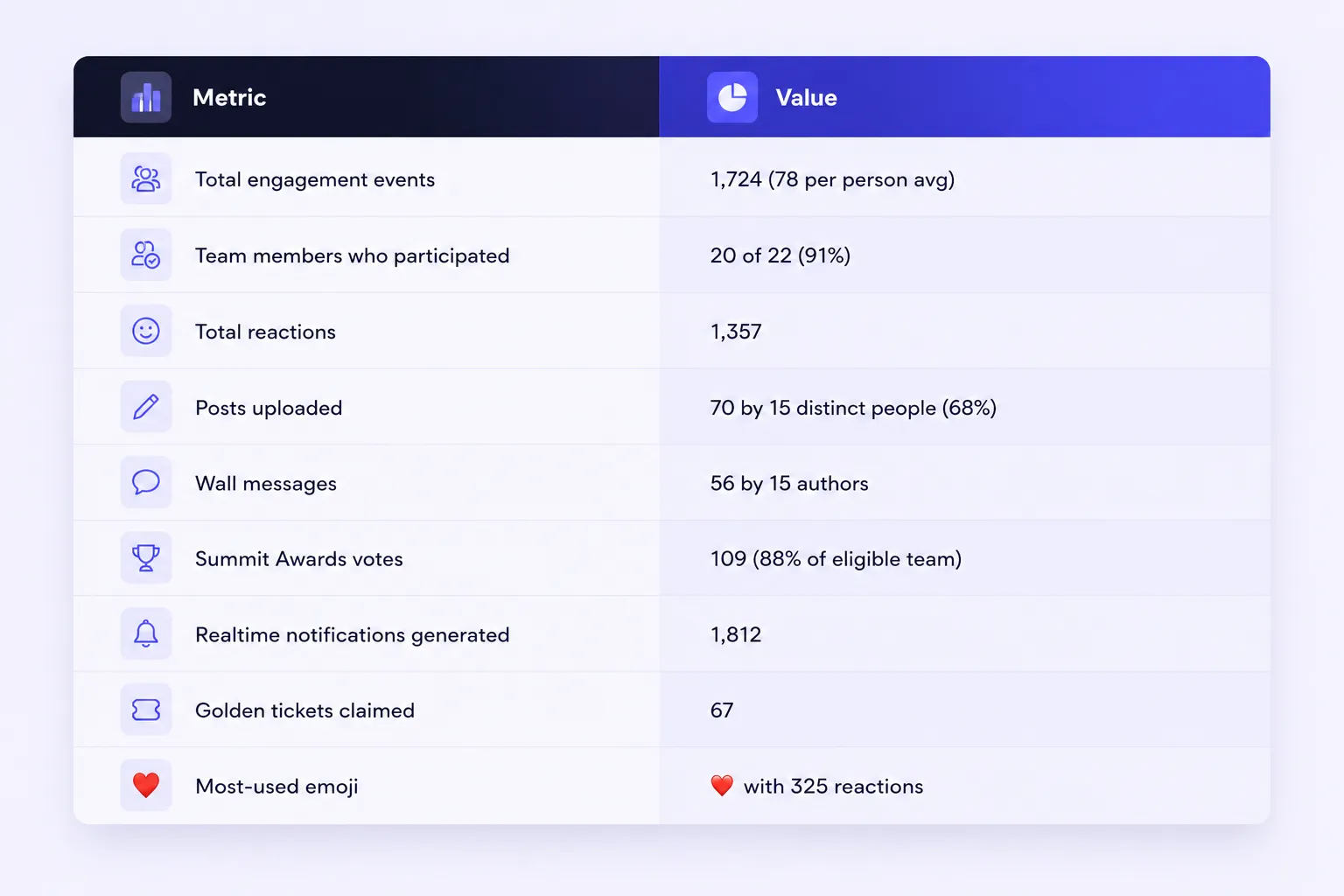
Three days after the event ended, Sebastian opened Slack, shared a screenshot of the gallery, and wrote:
"Que buenas épocas cuando publicábamos cosas acá." ("Those were good times when we used to post things here")
The message gathered blue hearts in silence.
That sentence is the inverse proof the site worked. If the absence creates nostalgia, the presence was real.
What didn't work (and what I did about it)
Critical pg_cron bug. The auto-promotion system ran every minute without an idempotency guard. It promoted three awards every minute until production had nine open awards instead of three. Fix: a SQL guard plus an atomic rollback of the six extras.
Auth gate temporarily removed. During development of Memories I removed auth.getUser() from the aggregator endpoint to validate visually with Playwright without logging in. I left it commented with // TEMP: auth removed. It almost stayed that way. Restored before final deploy.
Post-merge code review. After merging Awards to main I did my own review and found nine issues: SQL out-of-sync with runtime schema, a cast as never hiding a type error, a missing column for ties, bulk queries doing 264 round-trips instead of two, inconsistent terminology. Fixed in follow-up commits.
Lesson: the model does not guarantee self-review. That part is on you. Building with orchestration doesn't mean things come out perfect on the first try, it means you have far more iteration loops available, and the cost of each loop is low. This is exactly what our human-in-the-loop development approach is built around: AI produces the artifacts, humans catch what the AI cannot catch about itself.
What I learned about orchestration
Orchestration Feels Like Directing, Not Programming
My role was to make decisions, not to write code. I was deciding what to build, what not to, when the model was hallucinating, when it had to pivot. The loop: describe the desired outcome → model proposes → review → redirect → validate. The critical skill was the quality of the decisions, not the syntax.
This is the same conclusion our AI agents article reaches from a different angle: the human's value in an AI-augmented workflow is not execution, it is judgment. The PM who defines requirements. The architect who evaluates trade-offs. The reviewer who catches what the model cannot see about its own output.
Frameworks Matter More Than Ever
Aníbal Rojas, who later gave the workshop "Gen AI: Fundamental Principles" at the summit, has a checklist that applies directly: always leave an escape hatch in your prompts, define verification with measurable criteria, limit retries before changing strategy, and navigate with the wind when the model resists. Without those guardrails, orchestration falls apart. With them, it holds.
Marginal Cost Changes the Catalog
When building a feature drops ten times in cost, you don't build ten times more of the same. You build things that didn't exist in your vocabulary before. Easter eggs in an internal tool. A cron job that decides award winners. A reveal ceremony synchronized via websockets for 22 people. Things that, one by one, didn't justify the ROI. Together, they change everything.
IBM's research on AI agent systems frames this as the compound effect of reduced execution cost: the value isn't in doing the same work faster, it's in the new categories of work that become feasible.
What's Reproducible
The stack is not the lesson. Anyone can pick the stack. The reproducible part is three practices:
Start from the data contract, not the UI. If the database is well designed, RLS, relations, types, indexes, the rest flows. If it's wrong, no model will save you. Half the bugs in the first burst came from the UI asking for data the schema wasn't returning correctly. Once the schema stabilized, bugs dropped to near zero.
Turn every decision into a verification question. Not "is it good?" but "does it pass this specific check?" This shrinks the hallucination space dramatically. When the model knows exactly what it has to produce to consider a task done, it hallucinates less. When you say "implement X and make sure it works," it hallucinates a lot.
Learn to say when NOT to build. The model will give you whatever you ask for. The final quality depends on what you choose not to ask. The best days of those five days were not because of what I added, they were because of what I vetoed.
What This Means for Teams Like Yours
Ten years of Sancrisoft. Five days of orchestration. 22 people who said, "It's our own social network."
If the barrier to entry has fallen this far, the question is no longer whether you cross it. The question is what you build once you're on the other side.
For a nearshore development team, the implications are direct: the scope of what a senior engineer can deliver is no longer bound by the number of hours available. It is bound by the quality of their judgment, the clarity of their decisions, and the rigor of their review process. What used to require a team of four or five can now be orchestrated by one person with the right frameworks.
This is what we bring to every web development engagement at Sancrisoft, not just engineers who know the tools, but engineers who know how to direct them. How to define the scope. How to review the output. How to catch the bugs that the model cannot catch about itself.
If your team is evaluating what AI-augmented development actually looks like at production scale, not as a demo, but as 140 commits, 37 API endpoints, and a tool that made 22 people nostalgic when it went offline, schedule a consultation with our team. We'll walk through what this approach looks like applied to your specific product and team context. No pitch, just engineers showing you exactly how this works.